Life in Analogue
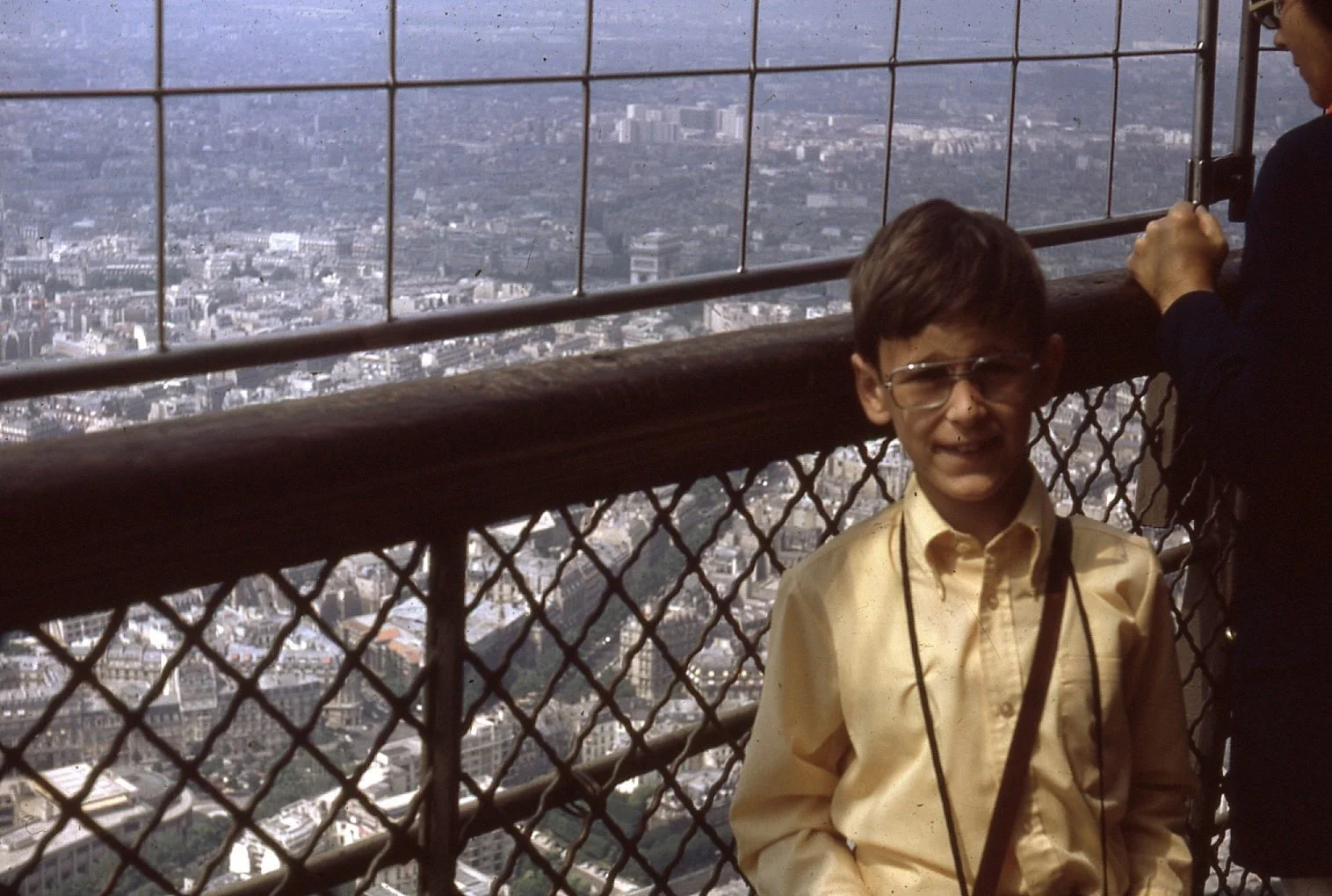
Paris, June 1973 with my first camera
Isn’t it easy to forget the excitement of our first photos? Bombarded with imagery on our phones the sheer joy of first seeing a picture of us or by us can slip our recall. We still see it when a child first sees their own photo, or perhaps when travelling to rural communities still beyond the digital age and showing what is on our phone screen. The emotions and thought processes that a photo can stir still can be as powerful as that first one. For me, that means it is worth the time and effort. Darkroom photography nudges me to revisit familiar negatives, to literally see them emerge afresh (slowly) through the magic of the developing tray. It is immersive and exciting in a way that I’ve never managed to experience working with a digital screen. I find joy in the process. Mistakes or unplanned results deliver continuing education or a fresh way of observing what had already been imagined. Content that I may have instantly deleted or effortlessly adjusted on screen just lingers in the darkroom, giving enforced time for reflection. When frames or prints are limited by time and money I am forced to consider “what’s the point of this one?”. I like that.
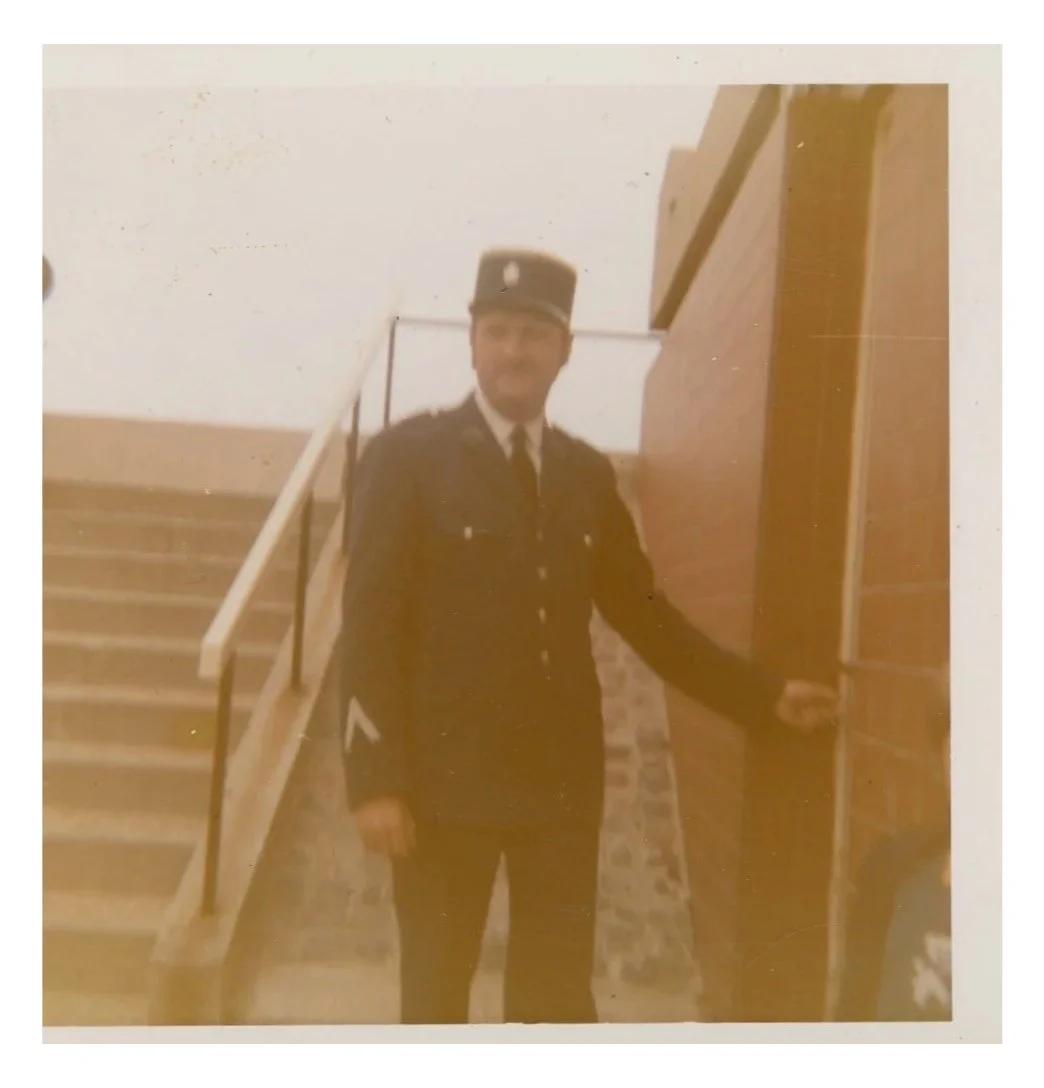
Gendarme, Normandy, France (1974)
It probably began as a defence mechanism for a quiet, insecure kid. A little boy in spectacles, moving from school to school, who preferred to play with the girls and was generally pretty bad at sport and deeply risk-averse. A camera can be a mask, turning the photographer into an observer rather than a lead participant, but nonetheless popular enough as the others play up to the camera. It can also be an identity. Being the “photographer” at an event provides the right to be there, when weak self-confidence would tell me otherwise. From the first box Brownie at 11 to my Soviet Zenit SLR at secondary school, the camera came with me. I can’t recall where the first camera came from, but as the first image of me with it was in Paris in 1974, I guess I was given it for that trip. That trip was a big venture for me and my Dad. At the time I was living with my grandparents and my elder brother, while my parents lived in a rented flat with my two other brothers. My Dad worked full-time as a policeman and with casual work delivering hire cars. Delivering a camper van to Paris was an opportunity for a young passenger to come along. I’ve never seen photos I took on that trip - I probably got something wrong. But I do have some pretty awful shots from a school trip to Normandy soon after. I probably had the nerve to ask the gendarme for a portrait in my primary school French, because I was familiar with the police (in a good way).
None of these first prints from school are particularly good, but all are important as stories and memories build around them. It was probably an unthinking process, just something a little nerdy to carry as a comfort blanket, until my great grammar school friend Parimal decided that we should set up a school camera club. I had to think a little more about “why?” and “what”. I now had someone to criticise what I produced. Mostly we spent time taking photos and very little time looking at whatever came back from printing.
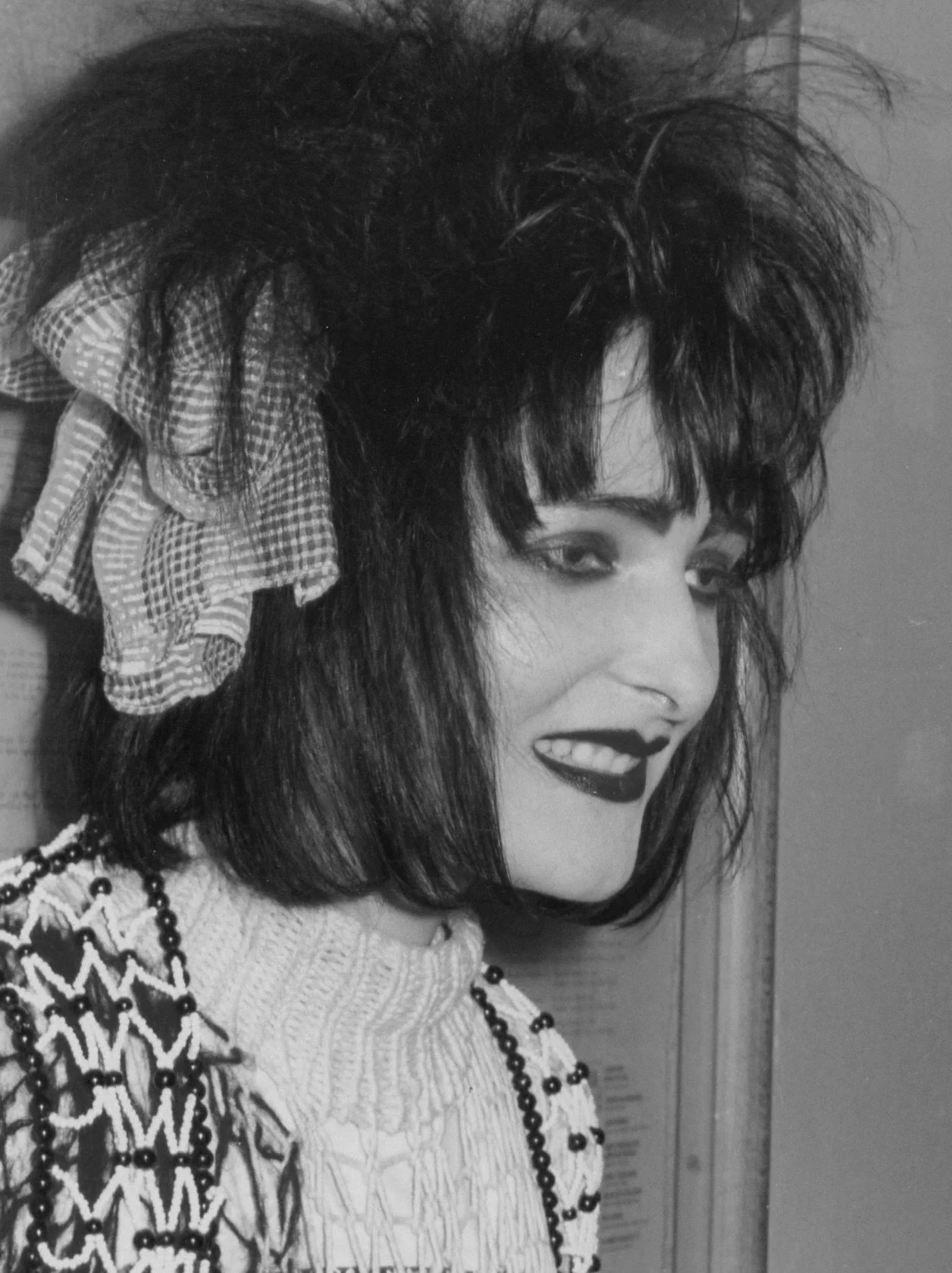
Siouxsie Sioux, London, December 1980
As a teen I discovered that the rare attribute of owning a “proper” camera worked as a free ticket to gigs, as a backstage pass, and to bands’ hotel bars. The magic of the photographers’ pass got me past security, sceptical that my ruse was legitimate for a teenager. The camera had taken me into situations that would have terrified me without the camera. It was the camera that allowed to come out of my shell and to appreciate that we are all much the same, famous or not. Sitting backstage with young rock stars or working late in the office with battle-weary Cabinet ministers it is impossible for our human insecurities and oddities not reveal themselves. The camera had led me on a journey of discovery in self-confidence and acceptance. It readily opened doors that I would not have dared push at without it. It directly got me backstage with my favourite rock stars as well as giving me a genuine reason to sail with one of the world’s most reveredspected ocean racers.
That is probably why the digital age hasn’t gripped me. Partly, photographing on film is my comfort zone: I still struggle to internalise the need to expose for the highlights in the digital camera, unable to rescue them later. I also have thousands of digital images, 99% of which I’ll never look at again and are even less likely to print. Partly, I just love the care that goes into exposing a frame of film, despite the fairly unpredictable outcome. It remains exciting, both to see the developed negative and, maybe, a print at some point. But, above all, for all the thousands of digital images on my devices the images on film just feel special. The slow joy of rediscovering them in the darkroom is similar to the hands-on act of playing music on vinyl.
The care becomes stronger the less images on a roll of film. A 12, 24 or 36 image limit becomes a positive limitation not a problem.