“No Fishing Sell Out” Hasting. 2026
Darkroom printing really is about the journey. For me it is a journey with a destination that is not precisely known. More stumbling along a dark path. There is some sort of vision of what I am hoping for, but there can be many chosen or forced diversions along the way. Sometimes the end is better than the vision. Other times it is far worse, but still an education.
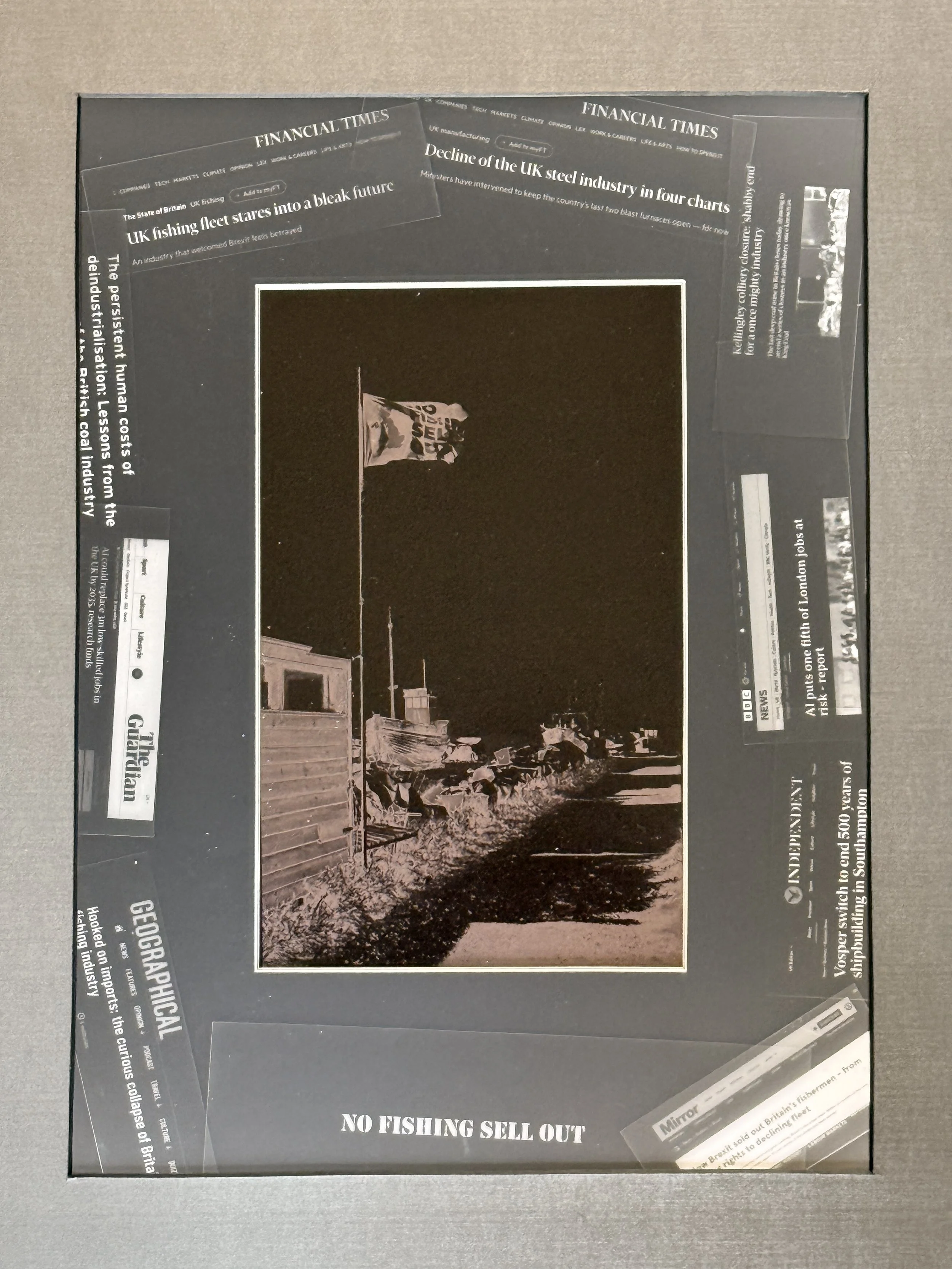
This is the story of what started as a simple photograph of a flag on the beach in Hastings. Seafaring in Hastings seems an exceptional endeavour. Boats have to be dragged in and out of the sea over the shingle. Both the fishing fleet and the lifeboat go to the same effort every time, often launching into surf that most of us would recoil from. Yet they maintain the activity regardless. The tattered flag that caught my eye in May 2025 read: “No fishing sell out”. It was surrounded by a cluster of boats and fishing gear, both in and out of use. Much of these were now rusting and rotting relics from a much larger Hastings fleet. Elsewhere on the beach owners and their families were working hard to keep their boats going, both traditional and modern.
It was more than a year later that I decided to look again at the negative on the light board. The spur was an Open Call for artworks around the theme of “crossroads and other junctions”. Flicking through my folders of negatives for inspiration the images from Hastings beach had me thinking about working communities that have faced huge critical junctures. My mother came from a family of Welsh coal miners. My father had started working life shovelling coal on steam trains. I started mine as a printer, working in the darkroom to produce plates for my printing press. Alongside steel, shipbuilding, and fishing, these working skills have been largely or totally displaced by technological advances and changing needs. They have all had their crossroads, with no going back. Film photography could, on a much smaller scale, be added to this list. What was once a large source of employment is now either a niche profession or an art form.
Could I use that image of a flag on Hastings beach as the centrepiece for these sentiments of change? Why is the UK so bad at preparing for these predictable shifts and supporting the affected communities through them? It seems that we prefer to fly the flag of hope rather than tackle the reality of constant change.
I wanted to emphasise some sorrow around the piece. The combination of solarising* the print and then toning it with sepia created, I hope, a darkness and timelessness that befits the story. I also wanted to make the point that this isn’t only about change affecting fishing. I selected a variety of headlines from other sectors hit by change. This had to include something around the decline and closure of the Vosper Thorneycroft shipyard in Woolston, Southampton. I grew up seeing those massive grey sheds and the new warships beside them, cycling past the big gates on my way down to the local sailing club.
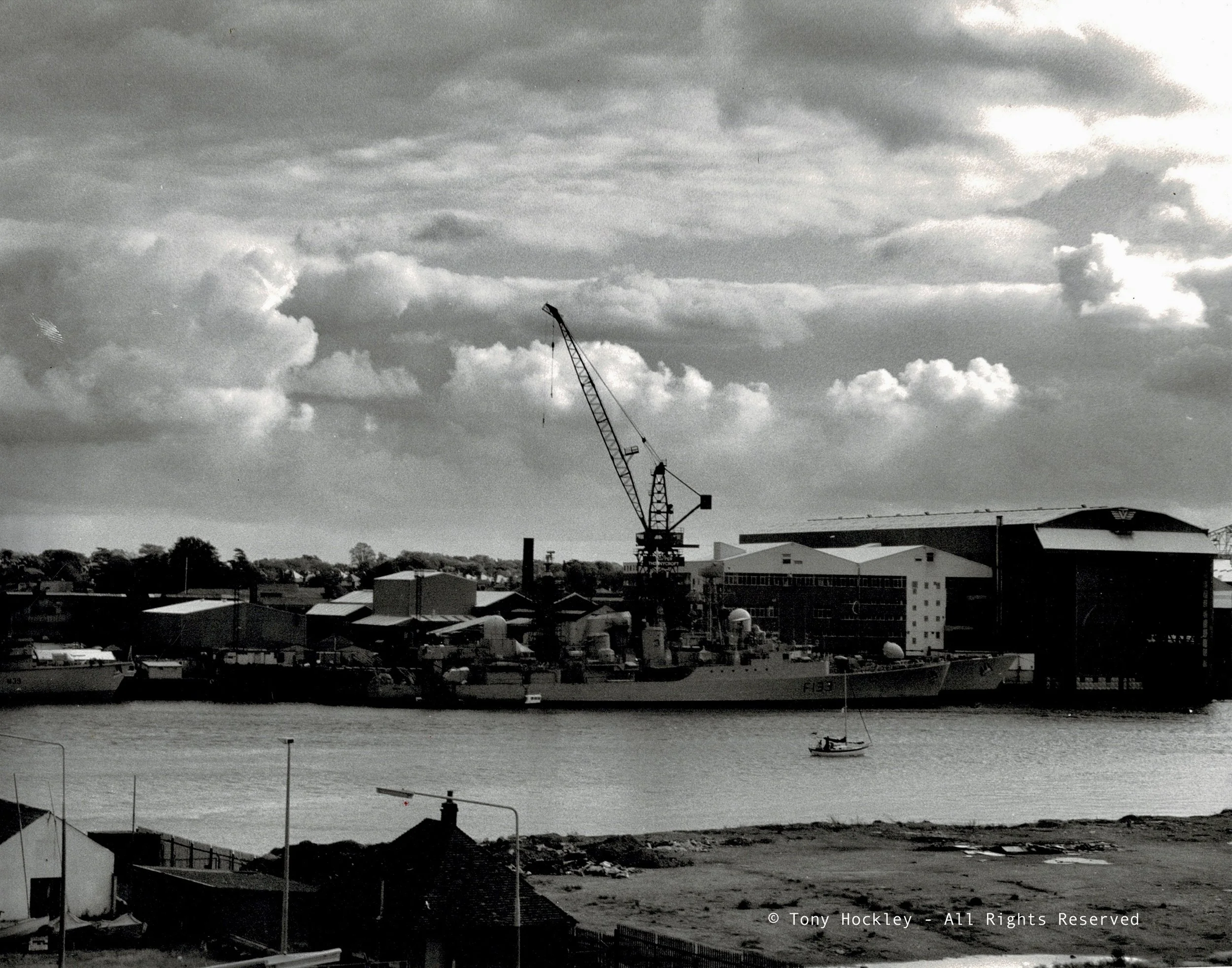
Vosper Thorneycroft, Woolston. 1984
[Image Vosper Thorneycroft]
It may be typical for industries affected by technological change that the comparison between the old and the new created some nostalgia for lost skills. As a lithographic printer in my teens I would be occupied with spotting out the “hickeys” on the negative before creating the printing plate or manually mixing inks to exactly the required print colour. These were enjoyable and challenging technical work. Selecting for perfection on a computer screen doesn’t compare in terms of satisfaction. I chose to move on. In my case it was a swerve into economics, which opened a path into politics and policymaking. Over time in this new direction it became clear that our democratic process does not encourage honesty about the industrial changes being faced, often beyond national control. This dishonesty means that the we never prepare local economies for the disruption that industrial change brings upon them; communities held together by their joint endeavour, whether coal, shipbuilding, fishing or another locally significant employment. Instead, communities are strung along with false hope and promises, then dropped into an entirely predictable crisis. The decline of coalmining, for example, was a steady process over a full century or more. It was simply left to whither, until the final and divisive showdown of the 1980s. Now in the 2020s many careers are about to be disrupted and displaced by the growth of artificial intelligence. Governments mostly run scared of honesty in industrial strategy, however great the impact.
I wanted to bring all of this together in the piece and to find a way to capture this in creating the Hastings print. The best way I could think to do this was to print digital negatives of the various online headlines, then contact print these onto photographic paper in the darkroom. This would be arranged in a way that they would surround the central print, creating a broader context for the image. This contact print was also solarised in the darkroom, to create a dark border. As I usually frame my prints with a mount I wanted to find a way to “print” onto the mount itself. The best I could do was to use a heat-sensitive board (usually used to give an artwork a more firm base, by adhering the two in a heat press), press the headlines print onto this and then cut this as a mount. To my surprise the experiment worked and the board cut in the same way as a standard piece of mount board.
This is one of those cases where the vision emerged along the way. At first I really thought that I would just make a solarised image of the flag on the beach. Thinking more about the “crossroads” theme I then just wanted to say more with the work about things that had fascinated me over many years working in the world of politics and policy. There is no dramatic sell out, just a bit of stumbling to the eventual end point. All a bit like the darkroom process.
Solarisation. (Also “The Sabattier Effect”). A darkroom print is exposed briefly to light during its development, as the final image is emerging. This fairly unpredictable process generates a semi-reversal from a positive to a negative image, with an interesting halo effect. It is very associated with Man Ray.